

Security leaders and frontline practitioners can look at the same organization, controls, and dashboards, and reach different conclusions about how well cybersecurity is working.
One side sees strategic progress, stronger alignment, and investments beginning to pay off. The other sees the alerts, workarounds, staffing constraints, and gaps that remain unresolved beneath the strategy.
The 2026 Bitdefender Cybersecurity Assessment reveals how consistently those perspectives diverge. Based on an independent survey of 1,200 IT and cybersecurity professionals across six countries, the report found that IT and security leaders rated their organization’s cybersecurity posture 8% higher, on average, than frontline practitioners did.
This is a cybersecurity optimism gap, and leaving it unaddressed can affect priorities, investments, and risk.
Leaders vs. Practitioners: Do We Have Internal AI Visibility?
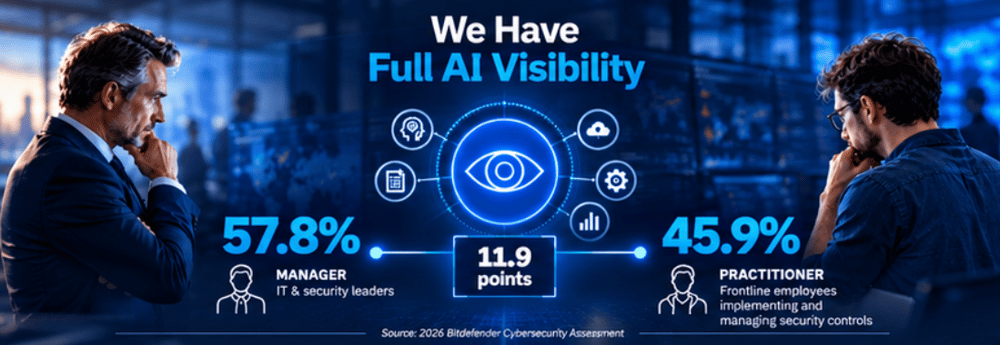
A major priority of most organizations right now is gaining visibility into internal AI use. This is also where the cybersecurity assessment uncovered the biggest perception gap between leadership and the frontline. Among managers and leaders, 57.8% say their organization has full visibility into the AI tools employees are using. However, only 45.9% of practitioners agreed, an 11.9-percentage-point gap the cybersecurity assessment uncovered.
“One of the hardest questions I could probably ask an organization today is, ‘Can you confidently tell me every AI platform your employees are using?’ For many organizations, the answer is no,” says Josh Armstrong, Senior Manager of the Bitdefender Global SOC.
What’s driving the perception gap here? Leaders may believe AI governance rests on a reasonably complete inventory, while practitioners closer to endpoints and user activity may see unknown applications, browser extensions, coding assistants, agents, and data connections keep emerging.
If leadership believes visibility is stronger than it actually is, the organization may underestimate its Shadow AI exposure, overestimate the reach of existing policy, or delay investments in tools that can identify internal AI use.
Leaders vs. Practitioners: Who Is More Optimistic About Security Improvements?
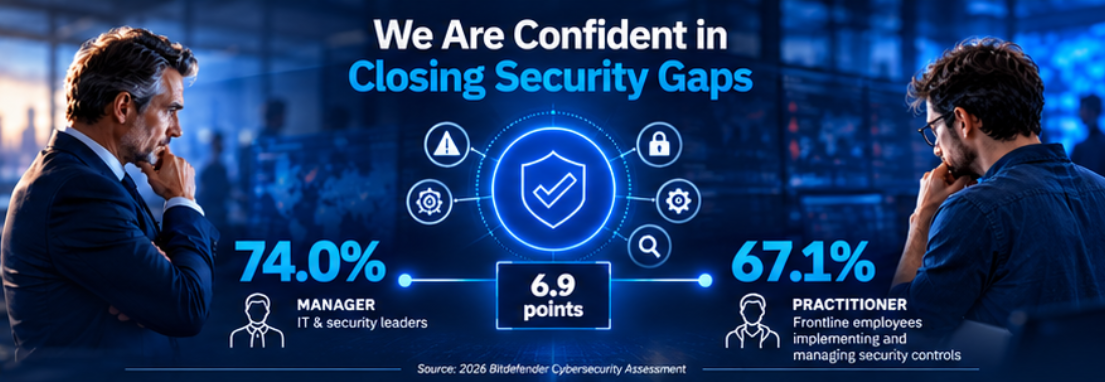
The cybersecurity assessment found that 74% of leaders expressed confidence in their organization’s ability to close security gaps, compared with 67.1% of frontline practitioners, a 6.9-point difference.
To leadership, a funded initiative, approved roadmap, or newly deployed platform can represent meaningful progress. Practitioners see it differently, says Bitdefender Technical Solutions Director, Martin Zugec. “Looking at this from the view of a security architect, you pay less attention to what is already secure, and you think more about everything that is unsecure that remains in front of you.”
Both perceptions can be valid at the same time.
Leaders vs Practitioners: Is Cybersecurity Aligned with the Business?
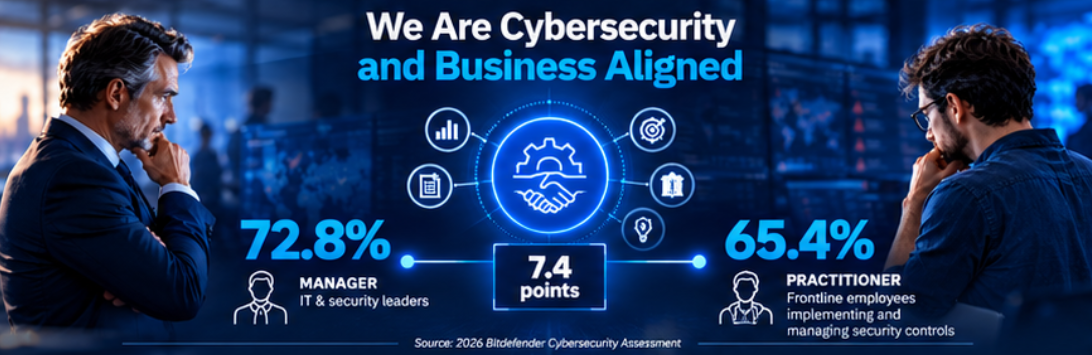
Leaders and managers were 7.4 points more likely to say cybersecurity is aligned with business objectives: 72.8% of managers said the two were aligned, compared with 65.4% of frontline practitioners, according to the 2026 Bitdefender Cybersecurity Assessment.
Executives and managers often experience alignment through budgets, governance meetings, and strategic plans. Frontline teams experience it through operating decisions: whether security requirements are introduced early, business owners accept necessary controls, and teams receive enough time and resources to implement them.
Alignment written into a strategy is important. Alignment experienced in daily operations is what makes it real.
Leaders vs Practitioners: Can We Address the Security Skills Gap?
The perception gap narrows when respondents consider workforce development. Nearly three-quarters of leaders, 73.7%, said their organization understood which internal cybersecurity skills it needed to develop. Among practitioners, 68.7% agreed, creating a five-point gap.
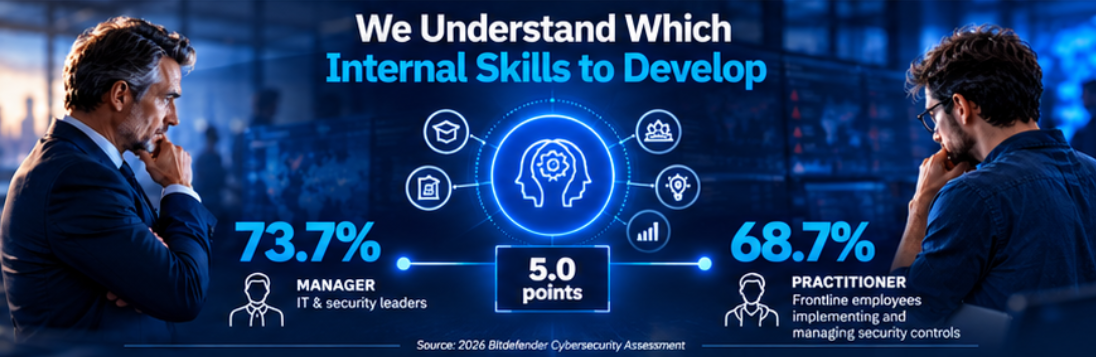
Knowing which skills are needed is only the beginning. Frontline teams also see whether employees have time to train, whether expertise is applied, and whether staffing levels allow those skills to make a difference.
This is where workforce strategy meets operational capacity. A skills plan may look complete from above while still feeling out of reach to the people expected to carry it out.
Leaders vs Practitioners: Is Compliance Overwhelming?
Compliance adds pressure to the majority of those working within cybersecurity.
According to the cybersecurity assessment, 65.2% of leaders and managers say compliance feels overwhelming, but that number drops to 58.1% when it comes to practitioners. This is a 7 point perception gap.
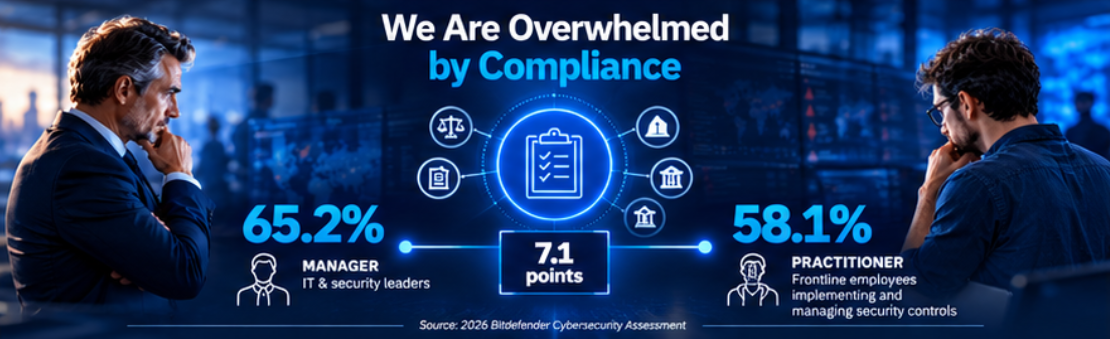
This may reflect leadership responsibilities for interpreting requirements, demonstrating accountability, reporting to boards, and directing limited resources. Practitioners may feel the operational burden of compliance, while leaders feel its organizational and reputational weight.
What Overall Factors Lead to the Cybersecurity Optimism Gap?
“The gap will continue to be a challenge, because the people on the front line are seeing a lot more of the day-to-day activities, so they understand more of every single gap,” says Nicholas Jackson, Director of Cybersecurity Services at Bitdefender. “The industry is still in a position where a lot of the data that the frontline workers are providing to managers are either piecemeal, incomplete, or even based on assumptions. As a result, I think managers often end up with a false sense of confidence.”
How Can I Read the Complete Cybersecurity Assessment?
Download the complete 2026 Bitdefender Cybersecurity Assessment to explore the findings and see where perception and operational reality may be diverging inside your organization.